

Most organizations have something in place for email protection.
But few feel confident answering questions like:
When email security is treated as basic filtering or an optional add-on, gaps form quietly…and attackers take advantage of them.
A solid disaster recovery plan removes that uncertainty.
It defines exactly how your systems and data are restored, who executes each step, and how fast operations resume. Based on your specific risks, not a generic template.
But most organizations don’t fail compliance because they lack technology. They fail because controls aren’t documented, policies haven’t been tested, staff training hasn’t been recorded, and no one is quite sure what auditors are actually evaluating.
Geographic threats, physical vulnerabilities, infrastructure dependencies, and human factors. Compliance for regulated industries.

Define Recovery Point Objectives and Recovery Time Objectives. Map system priorities. Keep protection active with cloud security and 24/7 monitoring.

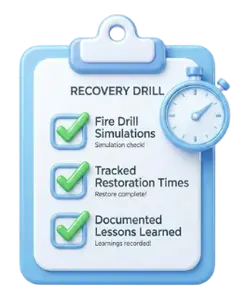
Test with fire drill style simulations. Track restoration times. Document lessons learned. When something breaks, the response is calm, coordinated, and proven.
Disaster recovery only matters if it works when systems are actually down and data is actually at risk. Organizations trust this approach because it restores operations when conditions aren’t perfect and removes uncertainty when decisions need to happen fast.
They have never failed us whenever we have a crisis. The staff works well under pressure and always finds a solution.”

Get the answers you need to know so your business can recover from any disruption.