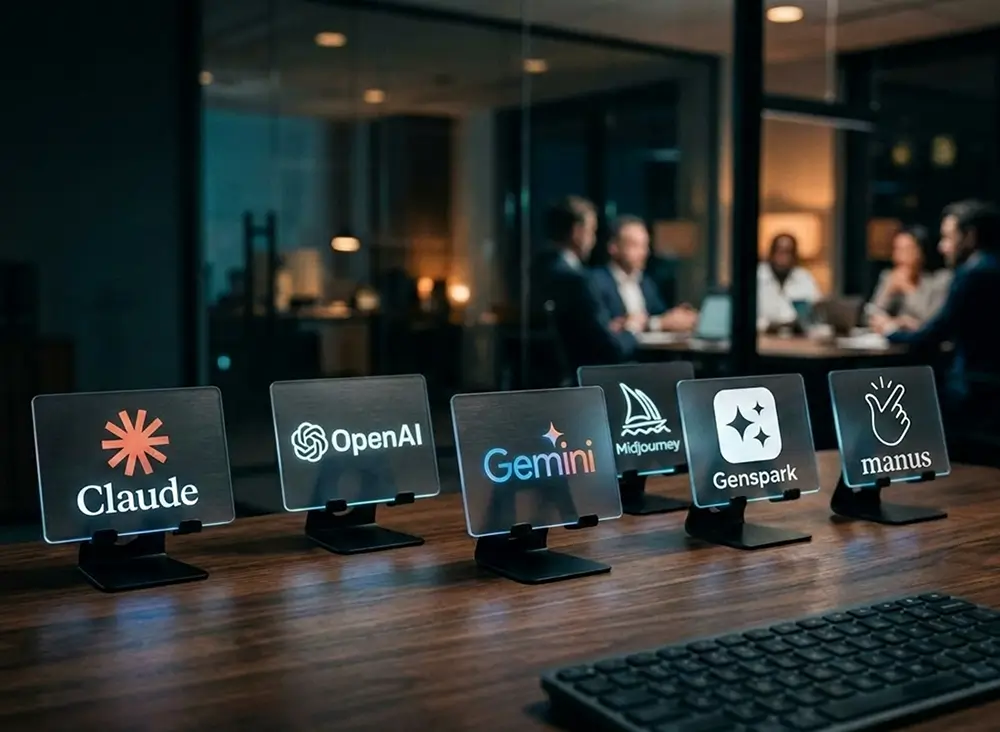

Row of glass nameplates on a wooden desk displaying Claude, OpenAI, Gemini, Midjourney, GenSpark, and Manus logos; blurred office meeting in background.

Where would AI actually make a difference in our operations?

Which of our processes are worth automating first?

How do we avoid investing in tools our team won't use?

Cost Reduction
0 %
Time Savings
0 %
Accuracy Rate
0 %
Months ROI
1 -6
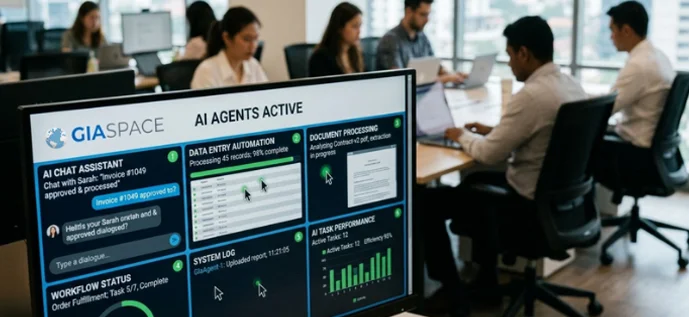
Office workspace with a computer monitor displaying an AI agents dashboard labeled 'AI AGENTS ACTIVE'.

Increased Productivity

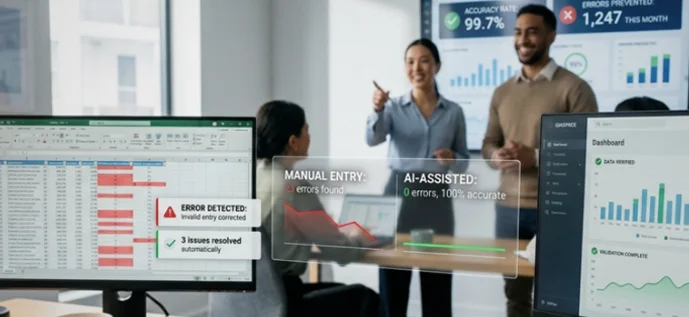
Office scene with four people presenting dashboards on multiple monitors displaying charts and graphs on a bright, modern floor plan.

Enhanced Accuracy

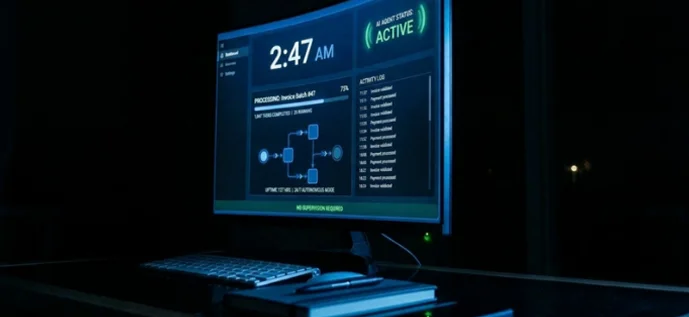
Computer monitor at night displaying a dark futuristic dashboard with '2:47 AM' and an 'ACTIVE' status, plus network diagrams and data panels.

24/7 Operations

Glass-walled conference room where a diverse team of professionals shakes hands after a meeting around a table, with laptops and charts visible.

Scalability

A Clear Process From Where You Are to Where AI Works for You.

AI consulting isn’t about picking software. It’s a structured process that starts with understanding how your business actually runs and identifying where automation creates real, measurable value.

Assess Your Operations

Your workflows and manual tasks are reviewed to find where automation creates the most impact, so you know what’s slowing your team down and where the best opportunities are.

Magnifying glass over interconnected gears, symbolizing system analysis or debugging in techsophisticated style.

Build Your Automation Plan

Each opportunity gets prioritized by impact and fit with how your team already works. The plan is sequenced so changes are manageable, not overwhelming.
Isometric view of two blue checklist cards showing a numbered to-do list with small icons (gear, badge, flask, airplane).

Implement and Integrate

Solutions are deployed in phases so your team is not disrupted. Each tool is configured around your actual workflows so your staff knows exactly what to expect.

Four interconnected blue puzzle pieces forming a square, symbolizing collaboration and integration.

Ongoing Support and Refinement

AI consulting isn’t about picking software. It’s a structured process starting with how your business runs and where automation creates real, measurable value.
Blue gear with an AI-centered core, wrench and chart icons, representing AI tools, maintenance, and optimization.

Regional Accounting Firm

200+ employees

“GiaSpace’s AI automation reduced our invoice processing time by 85% and eliminated data entry errors completely.”
Processing Time:
-85%
Error Rate:
-100%

Cost Savings:

$50K/year

Construction Company

500+ employees

“Project timeline optimization and automated resource allocation improved our project delivery by 40%.”

Project Delivery:
+40%
Resource Efficiency:
+35%
Cost Reduction:
$200K/year

Manufacturing Plant

1000+ employees

“AI-powered quality control and predictive maintenance increased our overall equipment effectiveness by 30%.”
Equipment Effectiveness:
+30%
Quality Defects:
-60%
Annual Savings:
$500K

Take Back Your Time

When the right processes are automated, your team spends less time on work that slows them down and more time on work that actually moves things forward.
The starting point is a clear picture of where that opportunity exists in your business.

Common Questions About AI Consulting

Get the answers you need to understand what AI can do for your business.

Yes. AI automation isn’t limited to enterprise organizations. Small and mid-sized businesses often see the fastest results because manual processes are more visible and easier to address quickly. The starting point is always your specific workflows, not a one-size-fits-all playbook.
The clearest candidates are tasks that are repetitive, rule-based, and time-consuming. Invoice processing, data entry, scheduling, reporting, and document management are common starting points. The assessment phase exists specifically to identify which of your processes fit that profile and where the return will be highest.
It supports them. The goal is to remove the work that slows your team down so they can spend more time on work that requires judgment, relationships, and expertise. Automation handles the repetitive parts. Your team handles everything else.
It depends on the complexity of the process being automated, but many organizations see measurable time savings within the first few months. The implementation is phased so early wins are visible before larger changes are introduced.
Resistance usually comes from tools that weren’t built around how the team actually works. The implementation process includes your staff from the start. Clear communication about what changes, proper training, and configuration that fits existing workflows reduces friction significantly.
Not necessarily. The assessment includes a review of your current environment so any gaps are identified before implementation begins. In many cases, existing infrastructure is sufficient. When it is not, the plan accounts for what needs to be addressed first.
Healthcare, finance and accounting, construction, logistics, manufacturing, and technology are the most common. Any business with repetitive operational workflows is a strong candidate regardless of industry.
Get IT Help Now